
Nanoparticle deposition using TGC
Nanoparticle deposition using terminated gas condensation (TGC) generates free nanoparticles in a controlled gas environment, giving researchers direct control over particle size, distribution and composition before deposition onto a substrate.
Introduction
Nanoparticle deposition by gas condensation is a method for producing very small particles, often only a few nanometres in size, and depositing them directly onto a surface. The process begins by heating a solid material until it becomes a vapour inside a chamber filled with an inert gas, usually argon. As the vapour cools, the atoms come together to form small clusters, which grow into nanoparticles. The gas flow carries these nanoparticles to a substrate, where they are deposited for use or analysis.
Because the nanoparticles are formed in the gas rather than in a liquid, the process does not require solvents, chemical additives or stabilising agents. This produces particles with clean surfaces, which is important in applications such as catalysis and biomedical coatings, where the surface of the nanoparticle plays a key role in performance.
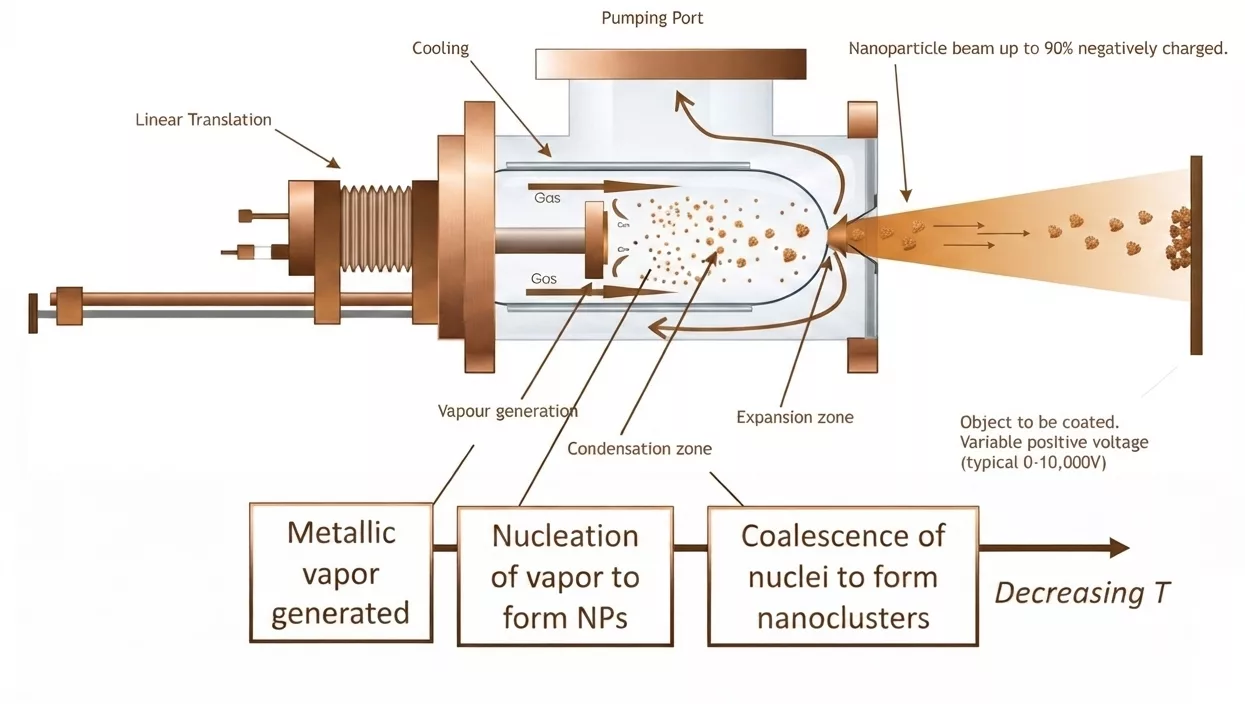
Terminated gas condensation (TGC) is a physical, solvent-free method for synthesising nanoparticles. A source material is vapourised, typically by magnetron sputtering, into a cooled inert gas atmosphere within an aggregation chamber. As the vapour cools and becomes supersaturated, atoms nucleate to form clusters. These clusters grow through atomic condensation and coalescence while they travel with the gas flow through the aggregation chamber. Particle growth stops at a defined aggregation length. The particle-laden gas is then extracted through a nozzle into a lower-pressure region and directed onto the substrate as a nanoparticle beam. Where precise size selection is required, a mass filter can be incorporated into the deposition path.
As nucleation and particle growth take place entirely in the gas phase, the process does not require solvents, reducing agents or capping agents. Particle size can be controlled by adjusting parameters such as sputtering power, inert gas flow, chamber pressure and aggregation length. This provides a controlled route to nanoparticles ranging from sub-nanometre clusters to particles measuring several tens of nanometres in diameter.
Terminated gas condensation (TGC) combines magnetron sputtering with inert gas condensation to produce nanoparticles under high-vacuum conditions. Atoms sputtered from the target enter a cooled inert gas, where repeated collisions reduce their kinetic energy. As the vapour becomes supersaturated, atoms nucleate to form clusters. These clusters grow through atomic addition and cluster coalescence while travelling through the aggregation chamber. The final particle size distribution depends on factors such as residence time, gas flow, chamber pressure and the temperature profile within the aggregation zone.
The process takes place under high-vacuum or ultra-high vacuum conditions, which limits contamination from residual gases. After leaving the aggregation chamber, the nanoparticle beam passes through a skimmer and differential pumping stages to separate the particles from the carrier gas. An in-line quadrupole mass filter can be used to select particles by their mass-to-charge ratio, producing a narrow size distribution at the substrate. This makes TGC well suited to studies of size-dependent physical properties and other experiments that require well-defined nanoparticle ensembles.
Terminated gas condensation (TGC) provides a solvent-free and ligand-free alternative to wet chemical nanoparticle synthesis. Nanoparticles are formed directly in the gas phase, so the process does not require reducing agents, surfactants or capping ligands. As a result, the particles have clean, chemically accessible surfaces. This is particularly useful for applications where surface chemistry is important, such as catalysis, surface binding and post-synthesis functionalisation.
The composition of the nanoparticles is determined by the sputtering target. Alloy and multi-component nanoparticles can be produced by co-sputtering from two or more targets. Because nanoparticle synthesis and deposition take place within the same vacuum system, the particles can be deposited directly onto the chosen substrate, including oxide supports for catalysis studies, without transfer, purification or redispersion steps.
Terminated gas condensation (TGC) provides a way to produce nanoparticles without the solvents, surfactants or reducing agents commonly used in wet chemical synthesis. Because the particles are formed and deposited under vacuum, their surfaces remain free from organic residues. This is important for biomedical applications such as implant coatings, drug delivery systems and nanoparticle-based diagnostics, where surface properties can influence biological response and experimental reproducibility.
The process also allows particle size to be adjusted within the same synthesis method. This makes it possible to investigate size-dependent effects, such as cellular uptake, toxicity and drug release, using nanoparticles produced under consistent conditions rather than comparing materials from different synthesis methods.
Key features
Areas of use
Nanoparticle deposition is used wherever researchers need very small, very clean particles placed precisely where they’re needed:
- Making catalyst particles for cleaner fuel and chemical production, such as green hydrogen
- Coating medical implants and devices to help the body accept them more readily
- Producing particles for sensors that detect trace chemicals, pollutants or disease markers
- Building test surfaces for spectroscopy, where nanoparticles boost a weak signal enough to be measured
- Studying how particle size on its own changes the way a material behaves
Because the particles are made without chemicals or solvents, they’re especially useful in research where surface cleanliness matters anything going near the body, or anything where trace contamination would skew a result.
- Heterogeneous catalysis : size-selected metal nanoparticles on oxide supports for structure–activity studies, free of ligand contamination that would otherwise mask active sites
- Electrocatalysis : nanoparticle electrodes for hydrogen evolution and fuel cell research, deposited directly onto conductive supports
- Biomedical implants : nanoparticle coatings on orthopaedic and dental implant surfaces for enhanced osseointegration
- Plasmonics and SERS : noble metal nanoparticle arrays for surface-enhanced spectroscopy substrates
- Magnetic nanoparticles : size-controlled particles for fundamental studies of superparamagnetism and magnetic switching
- Model catalyst systems : mass-selected nanoparticles for surface science studies under UHV, correlating particle size and structure with catalytic activity
- Size-dependent property studies : mass-selected clusters and nanoparticles for probing how optical, magnetic and electronic behaviour changes with particle size, free from the ligand shells that complicate wet-chemical samples
- Superparamagnetism and magnetic switching : narrow size distributions needed to correlate particle diameter with magnetic moment and blocking temperature
- Plasmonic and optical studies : noble metal nanoparticles for surface plasmon resonance and near-field optical work, deposited directly onto substrates suited to optical measurement
- Cluster physics and beam studies : gas-phase nucleation and growth as a testbed for cluster formation dynamics, coalescence and nucleation theory
- Surface science under UHV : nanoparticles deposited in situ onto clean surfaces for correlative studies with STM, XPS or TEM, without breaking vacuum
- Ligand-free catalyst synthesis : bare metal and alloy nanoparticle surfaces for catalytic activity studies where surfactants or capping agents would otherwise block active sites
- Bimetallic and alloy nanoparticles : co-sputtering from multiple targets to produce compositionally controlled alloy particles for structure–activity and selectivity studies
- Oxide and support interactions : direct deposition onto catalytic supports to study metal–support interactions without solvent-derived surface residues
- Reactive gas condensation : introducing reactive gases during particle growth to form oxide or nitride nanoparticles with controlled stoichiometry
- SERS substrate development : gold and silver nanoparticle films for surface-enhanced Raman spectroscopy, including trace detection of pesticides and controlled substances
- Implant coatings : antimicrobial and osseointegration-enhancing nanoparticle coatings on orthopaedic and dental implant surfaces, free of organic residues that could affect biocompatibility
- Nanoparticle toxicology and uptake studies : particles of controlled, consistent size from a single synthesis route, useful for comparing cellular uptake or toxicity across a size series without batch-to-batch variability
- Antibacterial surfaces : silver and silver-oxide nanoparticle coatings for antibacterial applications on medical devices
- Biosensing substrates : nanoparticle-enhanced surfaces for detecting biomolecules, pathogens or disease markers at low concentrations
- Drug delivery research : metal nanoparticle cores for functionalisation studies, produced without solvents or surfactants that would need to be removed before biological use