

Getting Signals into the Einstein Telescope: UHV Feedthrough and Cabling Lessons from ETpathfinder
At CERN in April 2026, Benjamin Holmes presented Allectra’s work supplying in-vacuum feedthroughs, UHV connectors and Kapton cabling for ETpathfinder, and what that experience means for the Einstein Telescope.
When people talk about next-generation gravitational wave detectors, the conversation usually turns to optics and seismic isolation. Connectivity gets less attention, but it is just as demanding. Thousands of low-noise signals have to pass in and out of an ultra-high vacuum system, at cryogenic temperatures, over hundreds of metres.
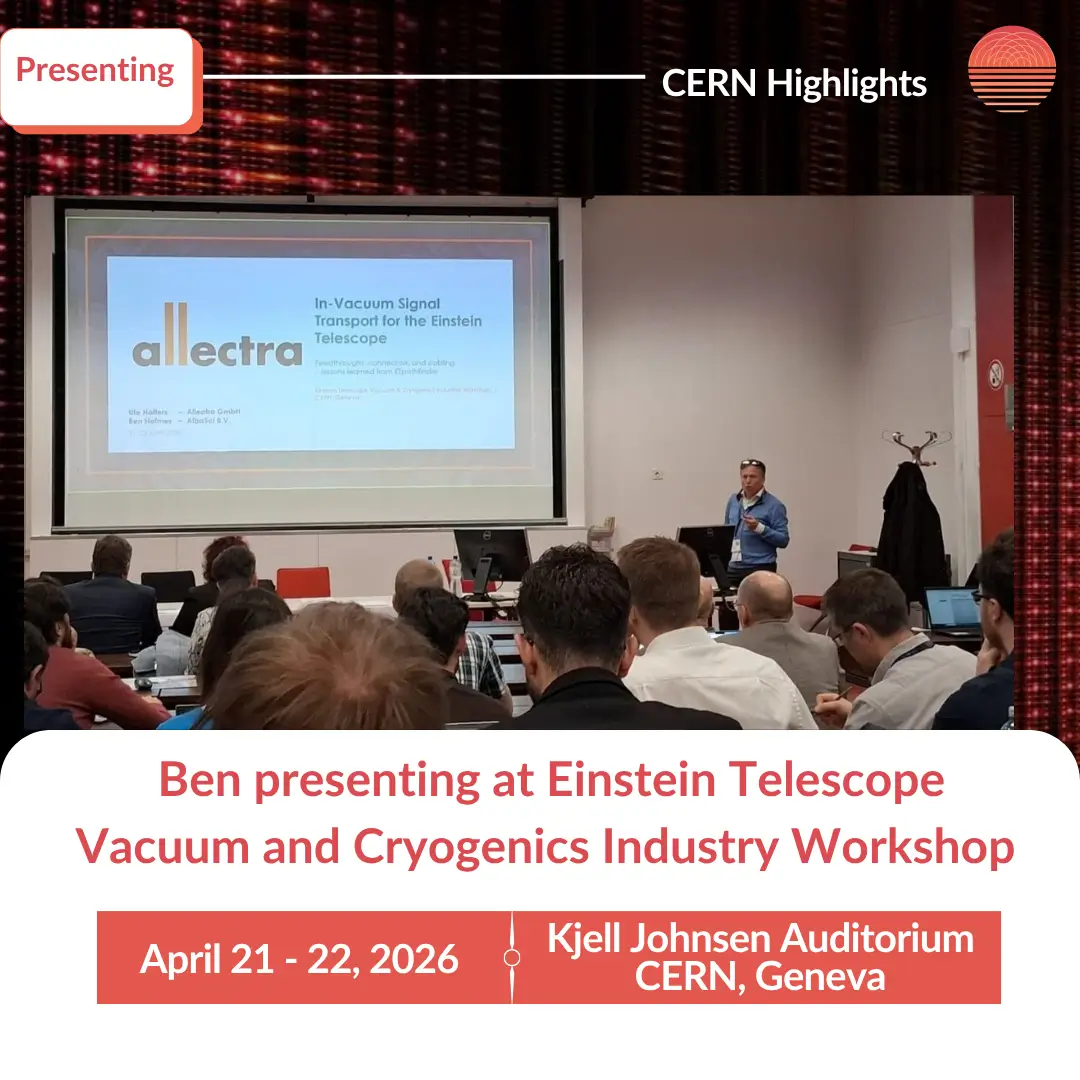
That was the focus of the talk Benjamin Holmes gave on behalf of Allectra at the Einstein Telescope Vacuum and Cryogenics Industrial Workshop, held at CERN in Geneva on 21 and 22 April 2026. Titled In-Vacuum Signal Transport for the Einstein Telescope, it shared the practical lessons learned from supplying ETpathfinder, the Einstein Telescope prototype.
The engineering scale of the Einstein Telescope
The Einstein Telescope (ET) will be a kilometre-scale underground observatory, with more than 100 km of UHV beam tubes and three nested interferometers. It is a step change in engineering as much as in science.
The cabling has to match that ambition. It means long runs, varied configurations and large quantities, all inside the vacuum, all low-outgassing, and all with no tolerance for failure.
ETpathfinder: UHV feedthroughs and cabling at scale
ETpathfinder was where Allectra put its capabilities to the test. For the prototype, Allectra supplied:
- 12 feedthrough flanges
- 124 connectors
- 300 m of in-vacuum cable
- 4,500 signals
The biggest engineering challenge was the flanges themselves. Each DN300CF flange carried 15 feedthroughs, and welding at that scale called for a new approach to quality control compared with standard, smaller flanges.
What Allectra is developing for the Einstein Telescope
If ETpathfinder was the rehearsal, the Einstein Telescope is the performance. Building on the prototype work, Allectra is focusing on four areas:
- 400-pin density: high-density feedthroughs, currently in development
- In-house Kapton cables: made on a dedicated production line in Germany
- Triaxial cables: low-noise cables for ultra-low current signals
- Proven quality control: QC protocols developed specifically for DN300CF feedthrough flanges
Download the presentation highlights
The highlights from the CERN talk cover the scale of the challenge, the ETpathfinder numbers and the technologies being developed for the Einstein Telescope.
Interested in UHV feedthrough and cable solutions for large-scale physics infrastructure? Get in touch
Follow us on linkedin