
PVD Systems
Compact
PVD
NL Cube
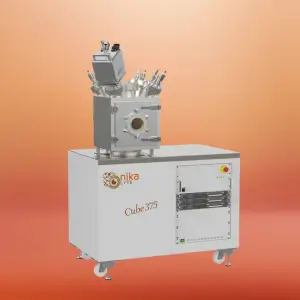
The NL-CUBE is a compact, versatile PVD system that combines nanoparticle generation and thin-film deposition in one cost-effective unit. Available in two versions the NL-CUBE 375 (five sources, 4-inch substrates) and NL-CUBE 300 (four sources, 2-inch substrates). It supports magnetron sputtering, mini e-beam evaporation, and nanoparticle deposition. Achieving vacuum levels down to 5×10⁻⁷ torr with 45-minute turnaround times, the system offers automated control, recipe programming, and datalogging. Ideal for labs needing advanced deposition capabilities within limited space and budget.
UHV
PVD
NEXUS
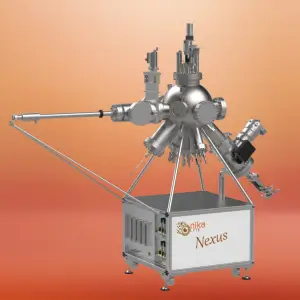
The NEXUS is a versatile UHV deposition system integrating multiple coating techniques for advanced materials research. It features a 3-headed nanoparticle source with QMS mass filtering, mini e-beam evaporator, magnetron sputtering, and thermal evaporation for precise multi-layer deposition. Substrate heating, rotation, and biasing options combine with automated, recipe-driven software for reproducible results. Compatible with third-party sources and load-lock integration, NEXUS provides hydrocarbon-free nanoparticles and excellent process control for catalysis, energy storage, photonics, and advanced materials applications.
Benchtop
Nanoparticle
NL 50
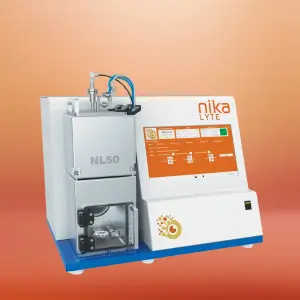
The NL50 is a compact benchtop vacuum system producing ultra-pure, non-agglomerated nanoparticles using the Terminated Gas Condensation Technique. It deposits metals such as Ag, Au, Cu, Pt, and Ni onto substrates up to 50 mm, offering precise size and composition control with real-time QCM monitoring. Features include plasma cleaning, room-temperature deposition for delicate substrates like graphene, and 30-minute cycles for rapid turnaround. Ideal for shared or teaching labs, the NL50 enables hydrocarbon-free nanoparticle deposition for catalysis, energy storage, photonics, and materials science without cross-contamination.
Looking for deposition components?
We supply UHV compatible PVD sources for nanoparticle deposition, e-beam evaporation and UHV magnetron sputtering