
Ultra-high vacuum (UHV) technology
Ultra-high vacuum (UHV) technology refers to the creation and maintenance of extremely low pressures, typically below 10⁻⁹ mbar, essential for minimising contamination in high-precision experiments and manufacturing processes.
Introduction
The air around us is full of tiny gas molecules. At normal atmospheric pressure, billions of these molecules are constantly landing on every surface. For everyday applications, this isn’t a problem. But in advanced research and high-precision manufacturing, even a small amount of contamination can affect results. Gas molecules can stick to surfaces, react with materials, and interfere with sensitive experiments.
An ultra-high vacuum (UHV) removes almost all of these gas molecules. UHV systems operate at pressures below 10⁻⁹ mbar around one trillion times lower than normal atmospheric pressure. This extremely clean environment allows scientists and engineers to study materials, develop semiconductor devices, and carry out precision measurements without unwanted contamination.
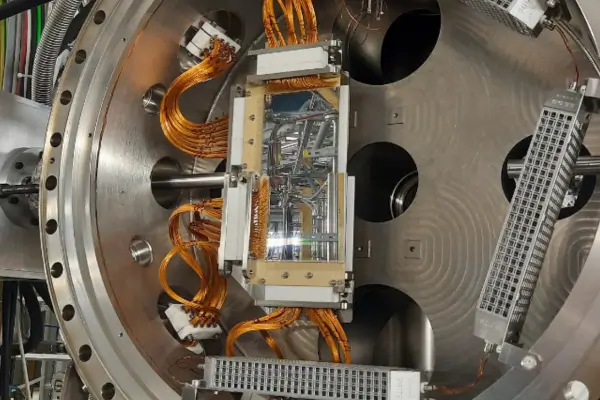
Creating a UHV environment requires specially designed vacuum chambers, high-performance pumps, leak-tight seals, and components that release virtually no trapped gas. Every part of the system is carefully engineered to maintain a stable, reliable ultra-high vacuum.
Ultra-high vacuum (UHV) systems operate at pressures below 10⁻⁹ mbar, where residual gas contamination is low enough to maintain clean, stable surfaces for extended periods. At 10⁻⁶ mbar, a surface can accumulate a monolayer of adsorbed gas in around one second. At 10⁻¹⁰ mbar, the same process takes several hours, making UHV essential for surface science, thin-film deposition, semiconductor processing and materials research.
Reliable UHV performance depends on the right combination of vacuum pumps, including turbomolecular, ion and titanium sublimation pumps, together with all-metal vacuum chambers using ConFlat (CF) flanges and copper gaskets. System bake-out, typically between 150°C and 250°C, removes water vapour and other adsorbed gases before the chamber reaches its base pressure.
Every component within the vacuum system, including feedthroughs, motion stages and internal hardware, must be vacuum compatible with low outgassing rates. Careful material selection, leak-tight construction and rigorous cleaning are essential for achieving and maintaining ultra-high vacuum performance.
In the ultra-high vacuum (UHV) regime, below 10⁻⁹ mbar, the mean free path of residual gas molecules is greater than the dimensions of the vacuum chamber. Gas transport is therefore governed by molecular flow, making conductance a key factor in system performance. Wide-bore connections, short pumping paths and carefully designed chamber geometry help maximise effective pumping speed.
At these pressures, the ultimate base pressure is usually limited by outgassing rather than pump capacity. Water vapour desorbing from stainless steel surfaces and hydrogen diffusing from the bulk material are the main residual gas sources. Bake-out, typically between 150°C and 250°C, accelerates desorption and reduces outgassing, allowing the system to reach a lower, more stable base pressure after cooling.
For extreme high vacuum (XHV), below approximately 10⁻¹¹ mbar, further reductions in residual gas require all-metal construction, low-outgassing materials, extended bake-out procedures and careful control of hydrogen diffusion. These measures are essential for achieving the pressure stability required in advanced surface physics, electron spectroscopy and precision experimental research.
From a materials perspective, UHV compatibility is governed by vapour pressure and outgassing behaviour under vacuum. Materials with high intrinsic vapour pressure, or that readily absorb and later release water and solvents, are unsuitable for UHV use regardless of their other properties this is why elastomer seals are generally replaced with metal gaskets, and why plastics and adhesives are avoided wherever possible inside the vacuum space.
Stainless steel remains the standard chamber material because of its combination of low outgassing rate, mechanical strength, and compatibility with bake-out temperatures, though careful attention is still needed to hydrogen content and surface preparation, since trapped hydrogen diffusing out of the bulk metal is a major contributor to long-term outgassing. Component and cable materials brought into contact with the vacuum insulators, wire coatings, lubricants — need the same scrutiny, since even small quantities of a volatile species can measurably raise system pressure or contaminate a sensitive surface experiment.
Ultra-high vacuum (UHV) is not used in most biological research, but it is essential for techniques that examine biological surfaces at very high resolution. These include electron microscopy, surface analysis of biomaterials, and the study of medical implant coatings, where a clean vacuum environment is needed to prevent contamination.
Biological samples present a challenge because they contain water and organic compounds that release gases under vacuum. Before UHV analysis, samples are typically prepared by dehydration, fixation or applying a thin conductive coating to improve stability and maintain vacuum conditions.
Once prepared, a UHV environment provides a clean, stable setting for analysing biological materials without interference from residual gases. This allows researchers to obtain more accurate information about surface chemistry, microstructure and biomaterial performance.
Key features
Areas of use
UHV technology sits behind many of the tools used to study and manufacture materials at the smallest scales:
- Manufacturing computer chips, where even a single stray molecule can ruin a layer
- Studying how atoms and molecules sit on a surface, using techniques like STM and XPS
- Building thin, high-performance coatings for optics, sensors and electronics
- Running particle accelerators and detectors that need a clean, stable environment to operate
- Supporting space and satellite instrument testing, where components must survive vacuum conditions
Because contamination at this scale can invalidate an entire experiment or process run, UHV components are chosen and engineered with far more care than equivalent parts used elsewhere.
- Semiconductor fabrication : chip manufacturing and thin-film deposition processes that require contamination-free process environments
- Surface analysis : enabling techniques such as XPS and STM, which depend on ultra-clean surfaces free from adsorbed contaminants
- Nanoelectronics and photonics : supporting device fabrication where surface and interface quality directly affects performance
- High-resolution imaging : providing the clean environment required for electron microscopy and related surface-sensitive imaging techniques
- Particle accelerator beamlines : maintaining molecular flow conditions over long beam paths to minimise beam-gas scattering and contamination of accelerated species
- Surface and interface physics : supporting STM, LEED, ARPES and related techniques that require atomically clean surfaces for meaningful measurement
- Cryogenic and low-noise instrumentation : combining UHV with cryogenic cooling for quantum devices and precision measurement, where thermal and vacuum stability both matter
- Detector and instrument testing : providing controlled vacuum environments for testing space-bound detectors and optical systems under representative conditions
- Surface reaction studies : studying molecular adsorption, desorption and surface chemistry on atomically clean substrates
- Thin film growth : supporting PVD and related deposition techniques that require contamination-free growth conditions
- Materials outgassing characterisation : evaluating candidate materials and components for vacuum compatibility before system integration
- Catalysis research : preparing and studying model catalyst surfaces free from adventitious carbon and other surface contaminants
- Electron microscopy sample environments : supporting SEM and related imaging techniques that require a clean vacuum chamber around prepared biological specimens
- Biomaterials and implant surface analysis : characterising coatings and surface treatments intended for biomedical devices under clean, controlled conditions
- Biosensor fabrication : supporting the deposition of clean metal films used as biosensing substrates
- Correlative surface studies : combining vacuum-based surface analysis with complementary biological imaging techniques on the same or related samples
Application areas
Deep reading